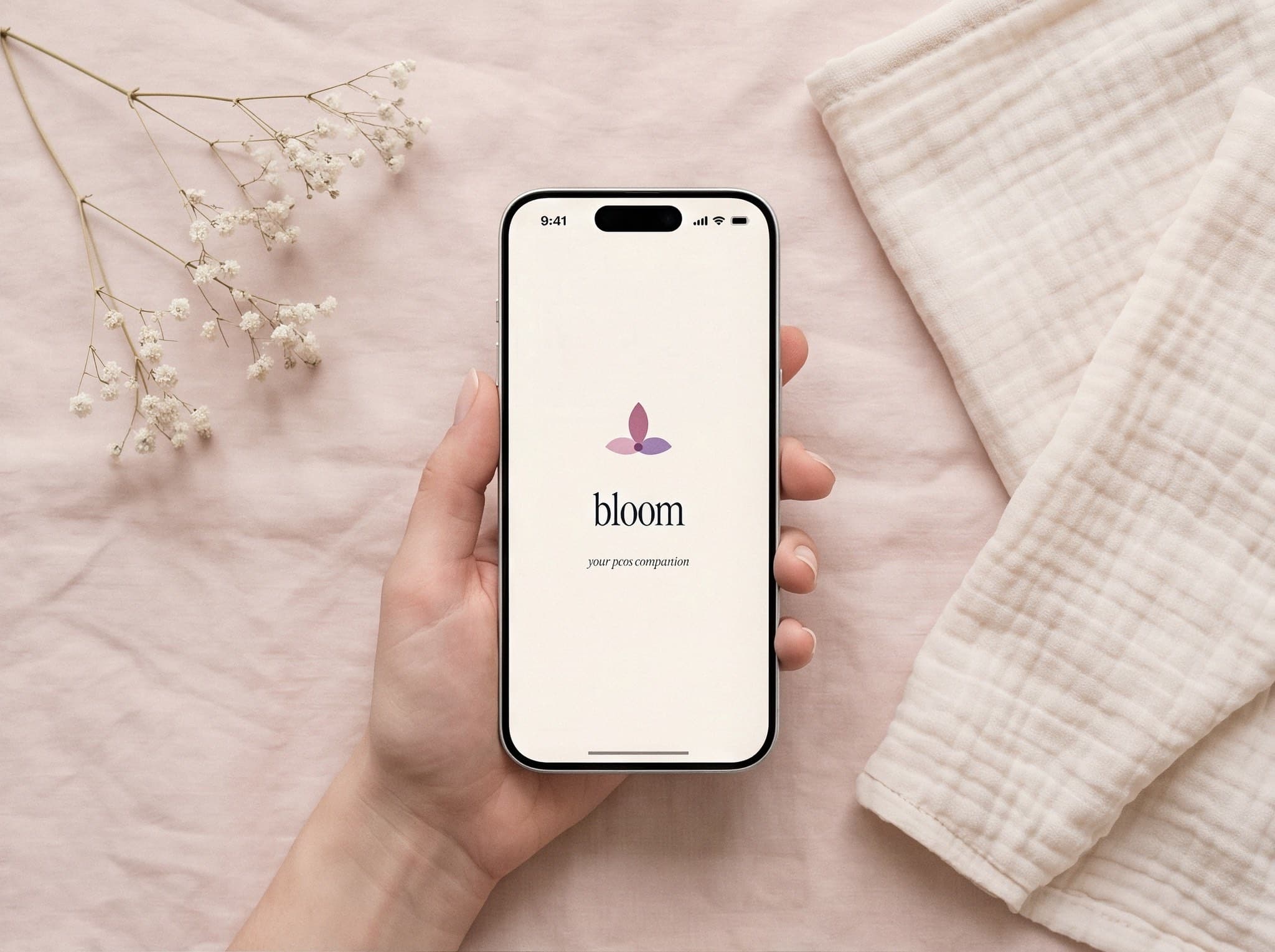
Bloom
A mobile companion for women managing PCOS — built because I had it, because no existing app understood what I actually needed, and because the information that changed my life shouldn't have been this hard to find.
Where it started
I've had PCOS
since I was
a teenager.
I was diagnosed young and handed a prescription for birth control. That was it. No explanation of what PCOS actually is, what's happening in my body, or what I could do about it. Birth control was the answer — except it's not really an answer. It doesn't treat PCOS. It masks the symptoms. The moment you stop, everything comes back.
So I started researching on my own. I read studies, followed endocrinologists, dug into the connection between insulin resistance and PCOS, learned about inositol, about how movement timing matters, about which ingredients in everyday products are endocrine disruptors that quietly make everything worse. I learned more from six months of self-research than from years of doctor visits.
And then I started tracking. Manually. In notes apps and spreadsheets. Because nothing I found was built for someone who wanted to actually understand their body — not just log their period.
The reality
This isn't a rare condition.
It just gets treated that way.
1 in 10
women of reproductive age have PCOS
70%
are undiagnosed or misdiagnosed
~10 yrs
average time to receive a correct diagnosis
#1
most common hormonal disorder in women globally
PCOS is the most common hormonal disorder in women — and most of us spend years not knowing we have it, or knowing we have it but not understanding it. The standard advice is generic. The apps are either period trackers dressed up with PCOS labels, or clinical symptom logs that feel like filling out a form. Neither helps you actually connect the dots between your daily habits and how you feel.
What I built
The app I wish
I had at 17.
Bloom started as a personal tool. I needed somewhere to track my supplements (inositol, magnesium, vitamin D — the things that actually moved the needle for me), my movement patterns, my meals, and how all of that correlated with my symptoms and cycle. I needed to see the relationships over time, not just log the days.
Habit tracking built for PCOS
Supplements, movement, sleep, diet — logged daily with PCOS-specific context. Not generic "health goals." Habits that are clinically relevant to managing insulin resistance and hormonal balance.
Ingredient scanner
The thing that shocked me most in my research: how many everyday products — skincare, food, household items — contain endocrine disruptors that silently worsen hormonal imbalance. Bloom lets you scan a product and see what's actually in it, flagged against a PCOS-relevant ingredient library.
Cycle awareness, not just tracking
PCOS cycles are irregular. Bloom doesn't just log dates — it tracks how you feel across phases and builds a picture of your patterns over time, so you start to understand your own rhythm instead of comparing yourself to a 28-day average that's never been yours.
Prototype · In Action
See how it feels to use it.
Prototype · Bloom v1
How it was built
Designed in Claude.
Powered by years of living with it.
I used Claude to generate the full design system — color tokens, typography, component specs, iOS-ready screen designs — in a single session. The design brief came entirely from my own experience of what I needed and what had always felt missing.
This is what vibe coding means to me: not just building faster, but compressing the distance between a real problem you've lived with and a product that actually addresses it. The research is the years of figuring this out myself. The execution is AI.
The app is in progress. When it ships, it'll be free — because the information that changed my life shouldn't cost anyone anything.