SaaS · AI Agents · Product Design · UX Research
NestAid — Reimagining Caregiving Operations with AI
What started as a marketplace connecting elderly people with caregivers evolved — through research — into a B2B AI operations platform that helps existing caregiving agencies manage their workforce, scheduling, and tasks using AI agents.
Role
Product Designer
Timeline
Dec 2025 — Present
Type
SaaS · AI Agents
Status
Active · Ongoing
Where We Started
The original idea: connect elderly people directly with caregivers.
NestAid was founded on a straightforward observation — aging adults need help with everyday tasks, and finding trusted, vetted caregivers is hard. The initial product concept was a two-sided marketplace: elderly individuals or their families could browse and book caregivers on-demand.
I joined as the first Product Designer in December 2025, embedded with the founding team from day one. My first responsibility was to validate the market before any UI was built.
Secondary Research
Before designing anything, we looked at the industry from the outside.
Secondary research gave us a macro view of the home caregiving market — its scale, its players, and critically, where the cracks were showing.
What the data kept pointing to
Established brands are struggling with operations
Companies like Home Instead, Visiting Angels, and Comfort Keepers — with thousands of clients — are still managing caregiver schedules through fragmented, legacy tools. Coordination is a constant fire-fight.
The staffing crisis is an operational crisis
With 64%+ annual turnover, the problem isn't finding caregivers — it's managing, retaining, and scheduling them efficiently. Coordinators spend 30–40% of their time purely on scheduling admin.
No-shows cascade into bigger failures
A single missed shift creates a chain reaction: urgent replacements, unhappy clients, caregiver burnout, and potential care quality issues — all because of a broken scheduling process.
The Pivot
The market already has caregiving companies. The opportunity is in helping them operate better.
Original Model (B2C)
Elderly → NestAid → Caregiver
A marketplace connecting individuals directly with caregivers on-demand.
New Model (B2B SaaS)
NestAid → Caregiving Agencies
An AI-powered operations platform that gives existing agencies the infrastructure to scale with confidence.
Instead of competing with established caregiving companies, NestAid would serve them. The gap wasn't in the number of caregivers — it was in the tools and infrastructure to coordinate them at scale. The real opportunity was in the backend: scheduling, task management, coordination, and communication.
This pivot fundamentally changed the product. We weren't building a marketplace anymore — we were building an intelligent operations layer for an entire industry.
Design Challenge
How might we help caregiving agencies eliminate scheduling chaos and reduce operational overhead — so coordinators can focus on delivering quality care?
Before & After
Two websites. Two completely different businesses.
As the business model evolved, so did the product. Here's a glimpse of what was designed for the original B2C concept versus where the product is heading now.
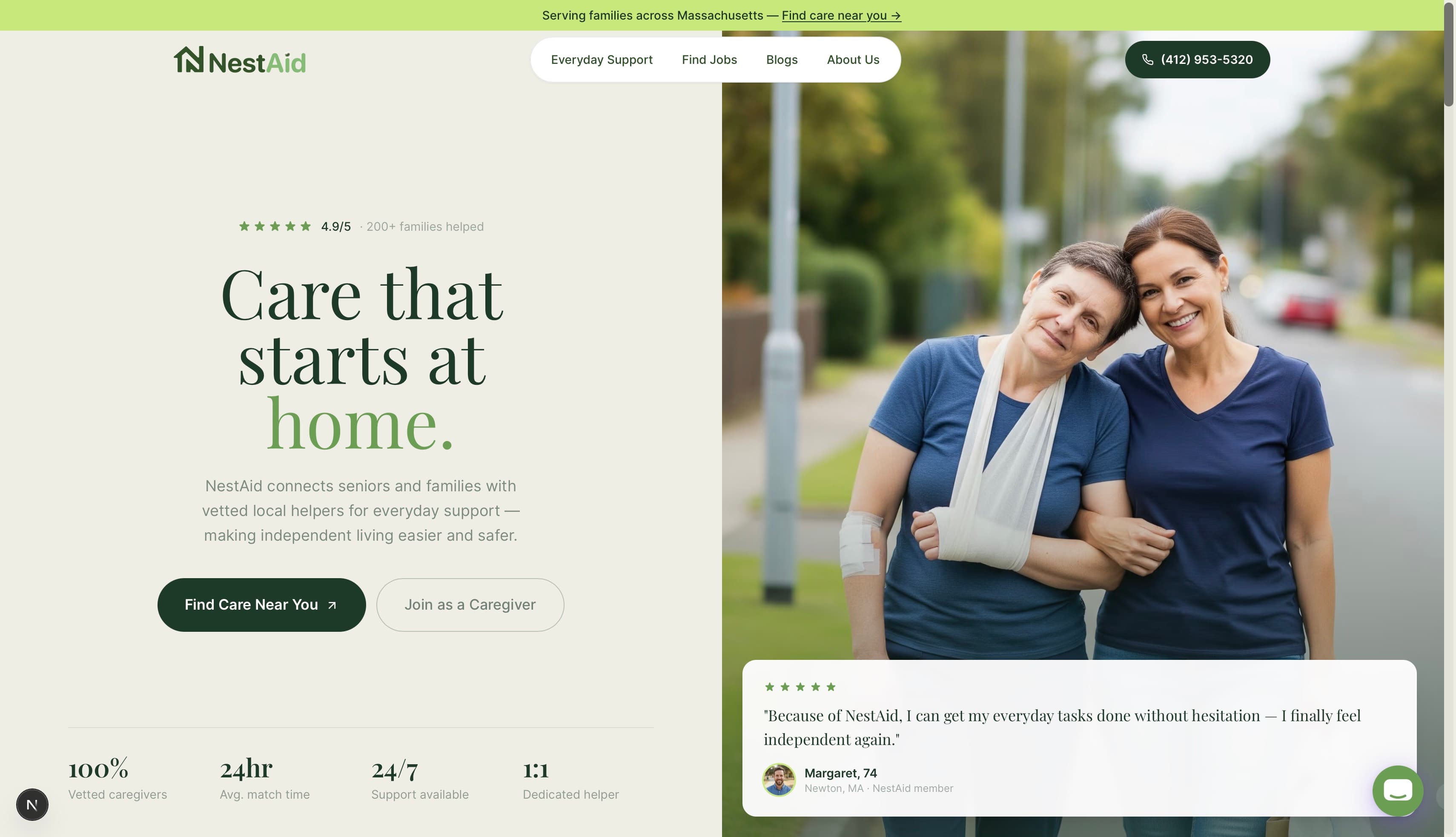
Designed for families searching for caregivers — a consumer-facing marketplace with browsing, booking, and caregiver profiles.
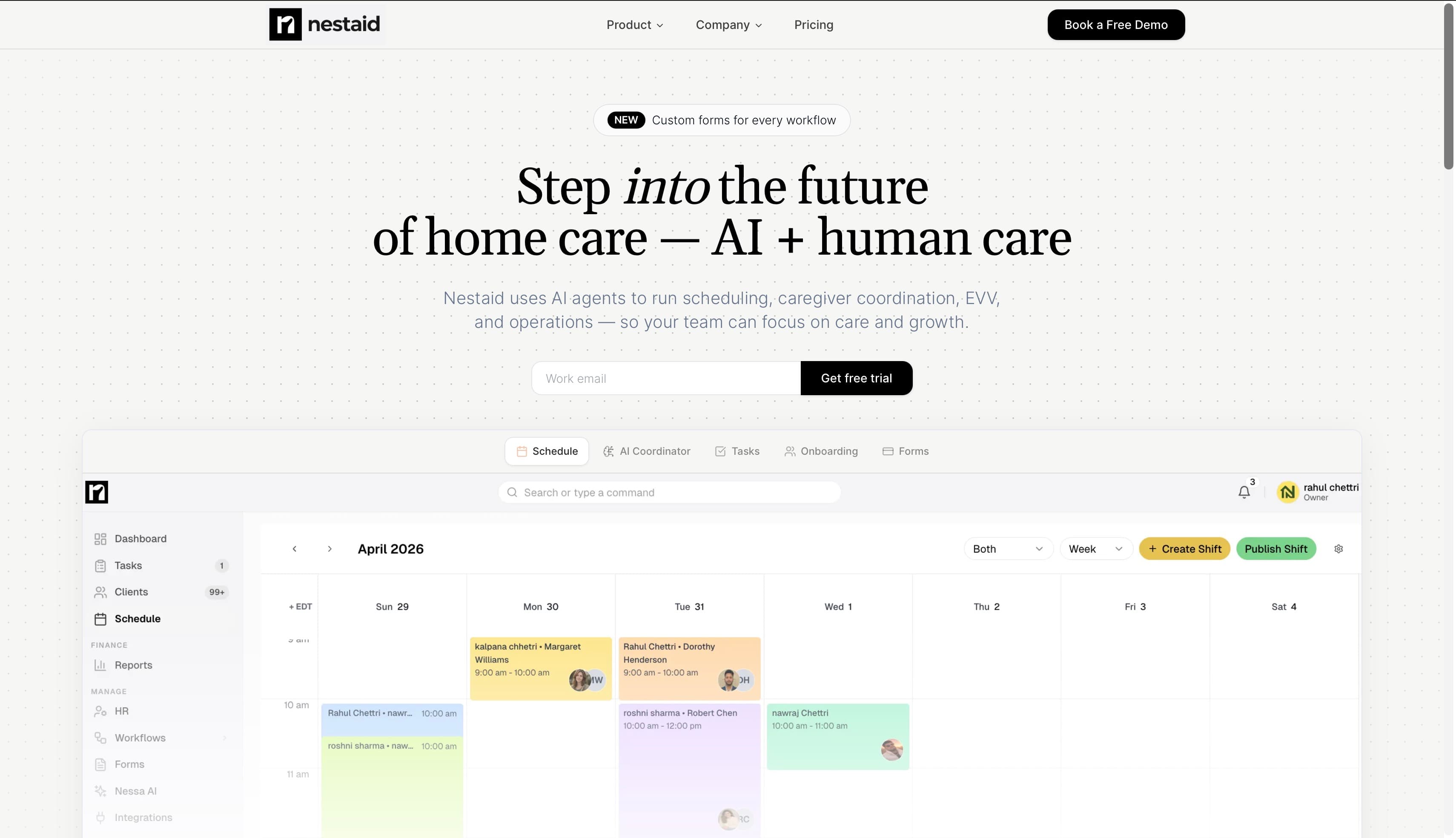
Redesigned for caregiving agencies — an operations platform centered around Nessa, AI-powered scheduling, and workforce management.
The Solution
Meet Nessa — NestAid's AI agent.
Nessa is the core value proposition of the new NestAid. An AI agent purpose-built for caregiving operations — handling scheduling, task delegation, shift management, and real-time coordination so coordinators can focus on care quality, not spreadsheets.
Intelligent Scheduling
Nessa understands caregiver availability, client needs, and location proximity to auto-generate conflict-free schedules — and adapt instantly when shifts change.
No-Show Recovery
When a caregiver cancels or doesn't show, Nessa proactively identifies a replacement and notifies all parties — without a coordinator lifting a finger.
Task & Care Plan Management
Coordinators can assign care tasks to caregivers through Nessa, who tracks completion and flags any gaps in care delivery.
Operational Intelligence
Nessa surfaces patterns: which caregivers are burning out, which clients need more attention, and where scheduling bottlenecks are forming — before they become problems.
My Role
End-to-end design ownership from day one.
Discovery & Research
- —Secondary market research
- —Competitive analysis of existing caregiving platforms
- —Stakeholder interviews with the founding team
- —Business model validation
Problem Framing
- —Synthesizing research into insight themes
- —Defining the B2B pivot opportunity
- —Reframing the problem statement
- —Aligning design strategy with business goals
Product Design
- —Nessa agent UX — conversation flows & task UI
- —Coordinator dashboard design
- —Scheduling interface
- —Wireframes & hi-fi prototypes
Ongoing
- —Iterating based on user feedback
- —Design system creation
- —Working directly with engineering
- —Participating in product strategy discussions
This is a live, ongoing project.
NestAid is an active startup I'm currently part of. This case study reflects the work done so far — research, pivot discovery, and early design. More to come as the product evolves.
Next Project
Usher Mobile App
AI/ML · User Research · Mobile Design